Indian yellow: the colour that came with a rumour
The warmest glow in Mughal and Rajput painting was said to come from one place in Bihar, by a method nobody could confirm for over a century. Then a chemist opened a 135-year-old jar.
Aurah Living · September 2026- Body
- Euxanthic acid salts — magnesium and calcium euxanthate
- Behaviour
- Transparent; a deep orange-yellow that fluoresces in light
- Era
- Miniature painting, 16th–19th c.; gone from commerce by c. 1921
- Tell
- Glows under ultraviolet — conservators find it in the dark
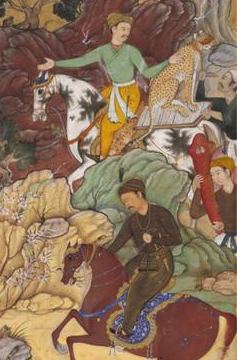
Look at the trousers on the rider above, and at the warm ground the whole hunt runs across. That family of yellows — transparent, honeyed, faintly glowing — is the colour this piece is about. Painters called it purree, or peori. Europe called it Indian yellow, and for most of two centuries nobody in Europe could say for certain what it was.
The rumour
The story that circulated was this: in the countryside of Bihar, cattle were fed on mango leaves, and their urine — collected, boiled down, strained, pressed into balls — yielded the pigment. It sounded like something invented to entertain a traveller. Most people treated it that way.
In 1883 a Calcutta civil servant named T. N. Mukharji went to Monghyr to check, on behalf of the director of Kew Gardens. He reported that he had seen it done, and sent a sample back. That single letter became, for more than a century, essentially the only eyewitness account in existence.
The doubt, and the jar
In 2002 the writer Victoria Finlay went looking — and found nothing. No oral memory of the trade in the region, no record of the law that supposedly banned production. She concluded, reasonably, that the whole story might be myth. For a while the sceptical version was the respectable one.
Then chemistry caught up. In 2018 researchers analysed Mukharji's own 135-year-old sample, still in the Kew collection, and found hippuric acid — a marker of urine. Separate metabolic work showed how a mango-leaf diet could actually produce euxanthic acid in the animal. The rumour was true. The one man who had bothered to go and look had been right all along, and it took a century and a spectrometer to believe him.
On the page
Laid thin, the colour warmed grounds and skies from behind — which is why so many of these pages seem lit from inside. Laid dense, it made the saffron of a robe carry across a room. The originals genuinely fluoresce; conservators still find the colour with an ultraviolet lamp. The tube sold as “Indian yellow” today is a synthetic impersonation. The glow on the restored pages is the real thing, fixed there since the seventeenth century.
Next in the series: lapis, and the long road ultramarine travelled to reach the page.
Purree
The trade name for the raw pigment balls. “Peori” and “gogili” are among its other Indian names.
Euxanthic acid
The molecule behind the glow — produced, remarkably, in the animal's own liver from compounds in the mango leaves.
The palette
Coming: lapis & ultramarine · vermilion · shell gold · verdigris · safeda white · lamp black.