What the empire had never seen, Mansur saw first
A dodo, a turkey, a falcon the emperor mourned, and a hundred flowers of Kashmir. Jahangir kept a diary of wonders — and one painter was its camera.
Aurah Living · September 2026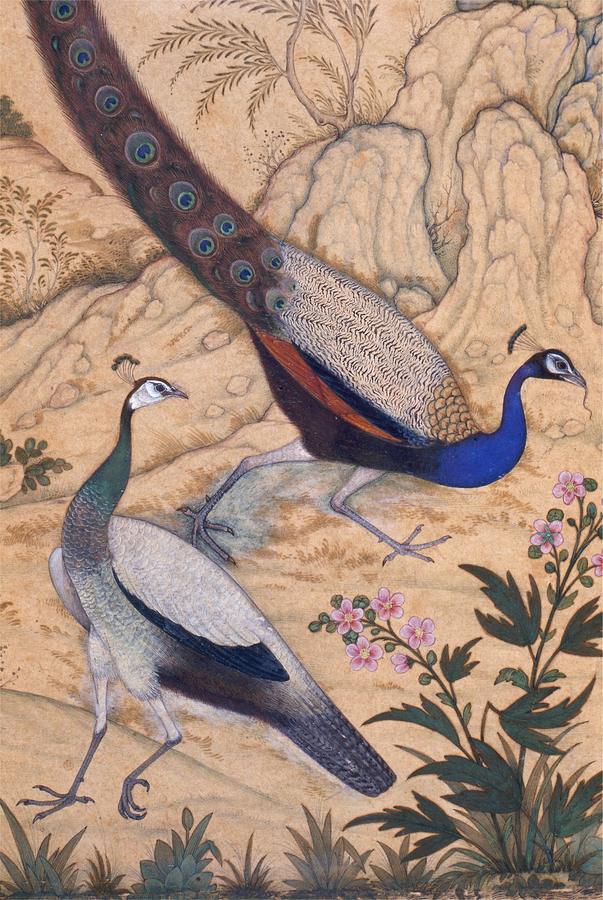
In 1612 a turkey-cock arrived at the Mughal court from Goa — a bird from the other side of the world, off a Portuguese ship, strutting in front of an emperor who had never seen anything like it. Jahangir's response tells you everything about the reign: he did not eat it. He had it painted.
The man he handed it to was Mansur, and by then this was already Mansur's job. He was the studio's naturalist — the painter assigned to whatever the empire had never seen before.
Unequalled of the time
Jahangir gave him the title Nadir al-Asr — Unequalled of the Age — twin to the honorific he gave the portraitist Abu'l Hasan. Titles like these normally went to poets. Under Jahangir they went to painters, and Mansur earned his with a portfolio that reads like a naturalist's life list: the first colour painting of a dodo; the first illustration of a Siberian crane; the turkey of 1612; a zebra, brought to court in 1621.
And the falcon. In 1619 a favourite Barbary falcon died, and the emperor's first instinct was not to replace the bird. It was to send for Mansur, so its likeness would exist before the body was gone. Grief, at this court, was a commission.
The diary and the camera
The clearest picture of how the two men worked comes from the emperor's own memoirs. In Kashmir he watched a dipper working the cold streams — a small bird that walks underwater — and could not identify it. The entry ends, simply: “I ordered Nadir al-Asr Ustad Mansur to draw its likeness.” The emperor observed; the painter verified.
A hundred flowers
Then, spring in Kashmir, 1621. The valley in bloom. Jahangir writes: “The flowers seen in the summer pastures of Kashmir are beyond enumeration. Those drawn by Master Nadir al-Asr Mansur the painter number more than a hundred.”
More than a hundred studies, from one season, by one hand. Almost none can be identified today with certainty; the tulip most often connected to that spring shows the bloom at several stages at once, the way European botanical engravings did. A painter borrowing a foreign way of seeing to record his own country's valley — that is the Mughal studio in one image.
What to look for
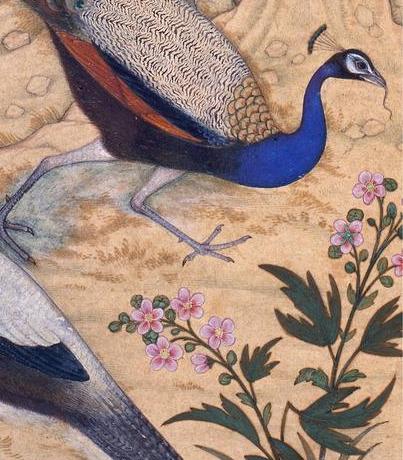
A Mansur bird is built from the feather outward — the barbs individually drawn, the weight of the body believable, the ground beneath it barely suggested. Nothing performs. The drama of a Mansur is that there is no drama; the bird is simply, unarguably there. Four centuries before the wildlife photograph, this was the standard it set.
Dodo, in colour · Siberian crane · turkey-cock, 1612 · Barbary falcon, 1619 · dipper, 1620 · zebra, 1621 · a hundred flowers, Kashmir 1621
Nadir al-Asr
“Unequalled of the Age.” Its sibling title, Nadir al-Zaman — Wonder of the Age, this magazine's namesake — went to Abu'l Hasan in 1618.
Muraqqaʻ
An album. Bird and flower studies were mounted with calligraphy and decorated margins — a garden you could hold.
The peacock and peahen, as a framed print — aurahliving.com
Prefer listening? Our podcast, The Garden and the Sword, waits at the end of this issue.